Photometry(last update 12-Aug-18)
Introduction
Photometry is the measurement of the brightness of an object. It can be done using any monochrome camera (with or without filters) on any telescope. Observations should be planned in advance and can be made as simple or advanced as members wish. Analysis of the results always gives a sense of achievement!
Observations may be submitted to the AAVSO and/or the BAA variable star section databases and this information is used to monitor the changes in brightness and period of the observed star.
Most of the stars I have photometrically observed are eclipsing binary systems (my particular interest). Observations of these with different colour filters can be used to estimate some parameters of these systems such as relative mass and radius, as well as some of the orbital parameters of the system.
Eclipsing Binary Systems
There are several types of eclipsing binary system, the main types being EA, EB and EW.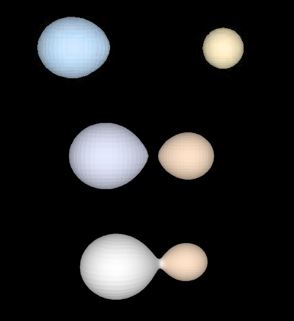
EA binaries – The two stars are far enough apart for their atmospheres
to be isolated (detached). These are also known as Algol types. The light curve is mainly flat between eclipses.
EB binaries – Beta Lyrae type. The atmospheres are semi-detached and the light varies between eclipses.
EW binaries – W Ursae Majoris Types. The stars are in contact and the onset of the eclipses cannot be determined.
Latest News (12-Aug-18)
Current observations include B, V, R measurements of V1828 Aquilae, an interesting binary system of a red dwarf and a white dwarf.
Updated observations of AC Bootis - completed light curve. (Recalculated using AAVSO data)
Information on eclipsing binary systems and their observation can be found here:
http://www.britastro.org/vss/Handbook15b.pdf
Past observations:
- BX Pegasi (EW) and KW Pegasi (EA) These are in the same field of view, 5 arcmin apart.
- ZZ Aurigae (EB) and V620 Aurigae (EA) These are in the same field of view 2.5 arcmin apart.
- UV Leonis (EA).
- SW Andromedae (RR lyrae pulsating star – not an eclipsing binary).
Currently observed stars:
- V1828 Aquilae (EA/HW). Light curve in progress. (see here).
- AC Bootis (EW) Light curve complete - getting extra data at eclipse points.
- RT Andromedae (EA) - Light curve being repeated with the photometric filters and AAVSO data.
Observations and Results:
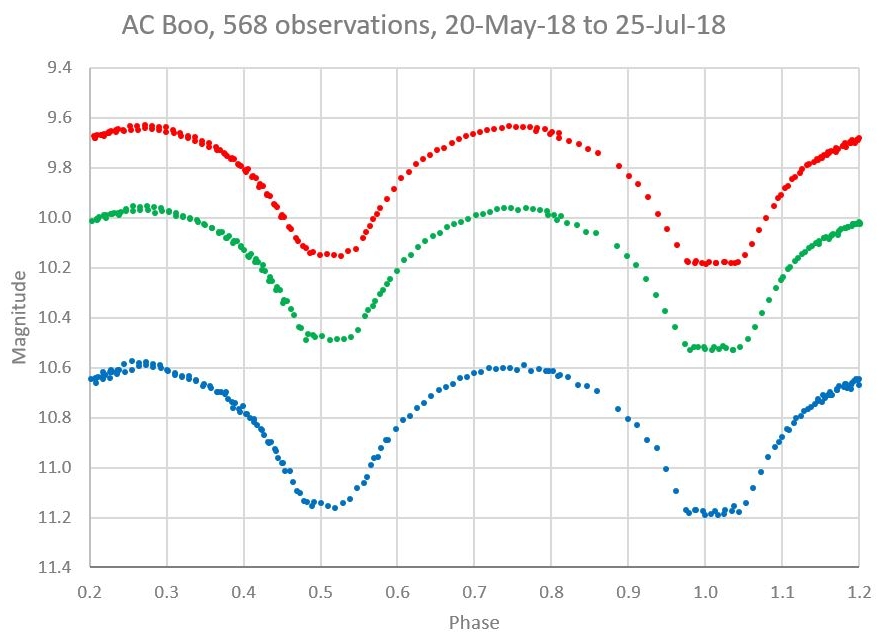
AC Bootis – Eclipsing binary, type EW
This star was chosen as a test target as it is on the BAA CCD target list
| Star: | AC Boo | = HIP 73103 | = BD +46 2004 |
| Variability (V): | 10.00 – 10.62 | secondary minimum 10.55 | |
| Period: | 0.3524540d | (8h 27m 32.0s) | |
| Reference star |
000-BMH-588 (TYC 3474-835-1) |
Mags (AAVSO Chart X23072AWW, star 111) B:11.724 , V:11.126 , R:10.822 |
|
|
BVR photometric observations |
|||
RT Andromedae – Eclipsing binary, type EA/RS
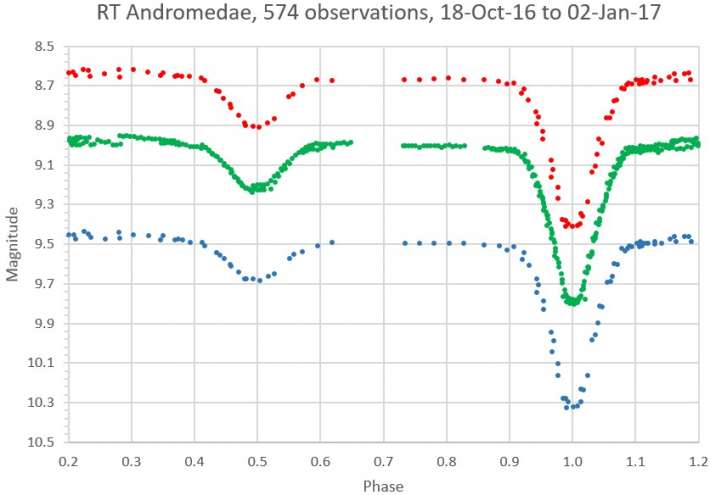
This star was chosen as the subject for a University of Portsmouth final year maths project in 2016/17. It was chosen as it has convenient period, magnitude range and is observable from August until February.
| Star: | RT And | = HIP 114484 | = BD +52 3383a |
| Variability (V): | 8.97 – 9.83 | secondary minimum 9.25 | |
| Period: | 0.62892857d | (15h 5m 39s) | |
| Reference star |
HD 236062 |
Mags (SIMBAD) B:10.25 , G:10.12 , R:10.05 |
|
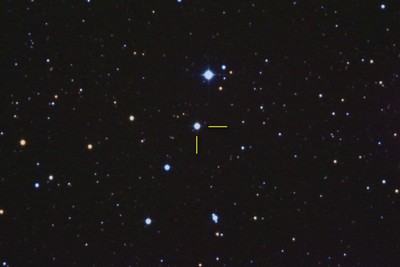
RT And star field
HAG 24" RC @ f8, Canon 700D,
150sec @ ISO 3200. FoV 15' x 10'
| 15 sec R,G,B observations with G4-9000 camera | B-R plot showing colour change during eclipses |
 |
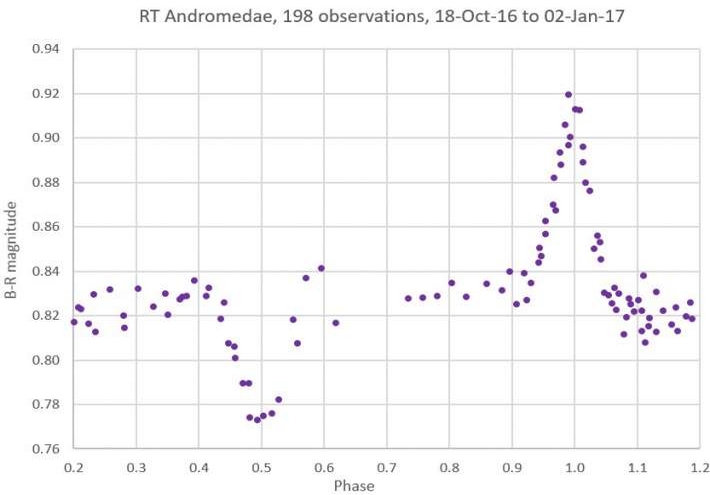 |
The project was successful and it is hoped to be extended using photometric filters to determine some of the star and system parameters.
These observations are being repeated with photomentric filters to compare results.
BX and KW Pegasi - Eclipsing binaries type EW/KW and EA respectively
These stars were chosen as they are only 5 arcminutes apart so they could both be observed in the same image. The study of BX Peg is the subject of a University of Portsmouth final year maths project for 2017/18.
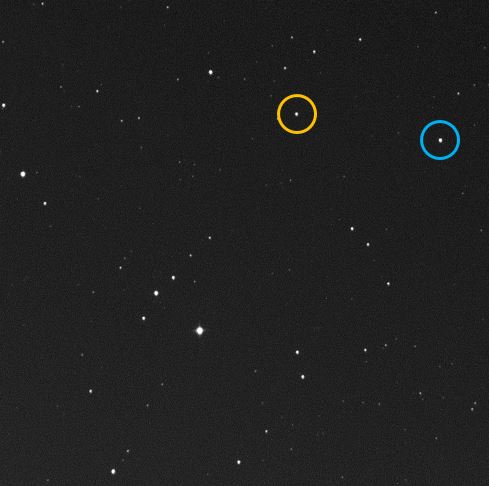
BX & KW Peg star field
HAG 24" RC @ f8, Moravian G4-9000
30sec Luminance. FoV 26' x 26'
YELLOW
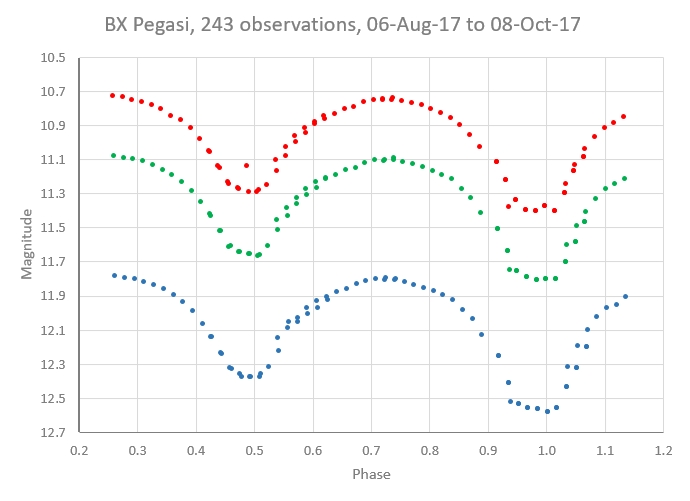
Star: BX Peg Type : EW/KW
Variability (V): 10.80 – 11.53
(secondary minimum 11.42)
Period: 0.2804173d (6hr 43m 48s)
BLUE
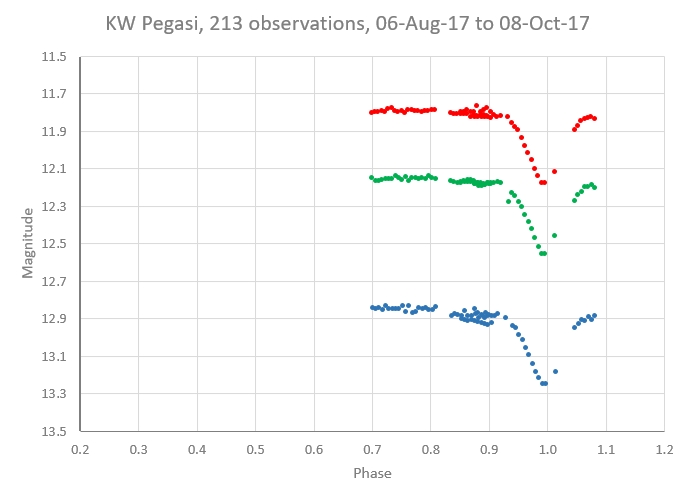
Star: KW Peg Type : EA
Variability (V): 11.9 – 12.30
(secondary minimum 12.20)
Period: 0.8164017d (19hr 35m 37s)
HAG 24” RC, G4-9000 camera, R, G, B filters, 30 sec exposures.
 |
 |
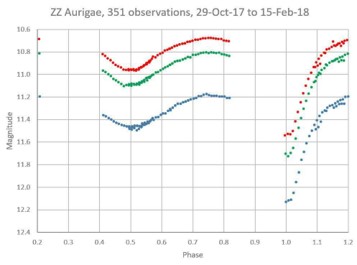
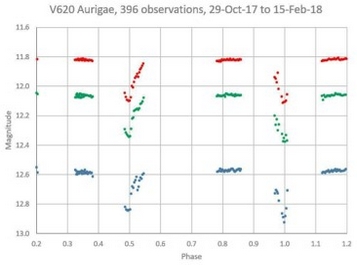
ZZ and V620 Aurigae - Eclipsing binaries type EB and EA respectively
These stars are only 2.5 arcminutes apart so they could both be observed in the same image.
ZZ aur was chosen as another University of Portsmouth final year maths project 2017/18.
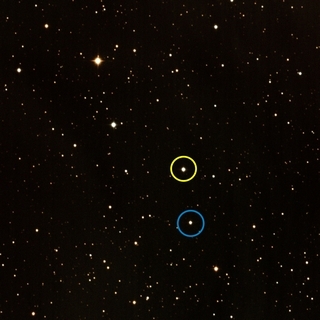
ZZ & V620 Aur star field
HAG 24" RC @ f8, Moravian G4-9000
18x45sec RGB. FoV 15' x 15'
YELLOW
Star: ZZ Aur Type : EB
Variability (V): 10.80 – 11.53
(secondary minimum 11.08)
Period: 0.601217d (6hr 5m 48s)
BLUE
Star: V620 Aur Type : EA
Variability (V): 12.03 – 12.38
(secondary minimum 12.3?)
Period: 1.503265d (1d 12hr 4m 42s)
HAG 24” RC, G4-9000 camera, R, G, B filters, 45 sec exposures.
 |
 |